
THE PROMISED COMFORTER
Léon Denis
The philosopher of Spiritism — the self-taught salesman who found The Spirits’ Book at eighteen and spent sixty years carrying Kardec’s work to the world.
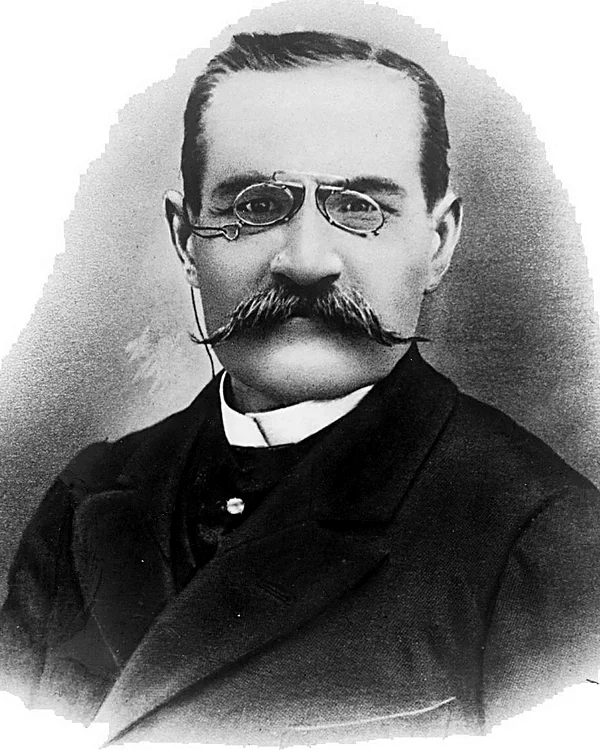
Léon Denis (1846–1927). Historical portrait, public domain; via the Centre Spirite Lyonnais Allan Kardec.
Allan Kardec organized Spiritism. Léon Denis is the man who carried it, explained it and defended it for nearly sixty years after Kardec’s death — and he came to the doctrine from about as far outside the academic world as a Frenchman of his century could.
A self-taught beginning
Denis was born on 1 January 1846 in Foug, a small village in Meurthe-et-Moselle, France, into a humble family. Necessity came early: as a boy he did manual work and carried heavy responsibilities at home. What schooling he got, he largely gave himself — reading serious books on his own, determined to develop his mind by his own effort. Biographers describe him as a serious, competent self-didact, and the description fits the whole of his life: everything Denis became, he built by study.
At eighteen he went to work as a sales representative, a job that kept him travelling. He loved music, played the piano, and lived simply. It was also at eighteen, browsing the shelves of a bookshop as was his habit, that his eye fell on a title that puzzled him: The Spirits’ Book, by Allan Kardec. He bought it with money he happened to have with him and hurried home to read it. His own comment on that reading, preserved in the biographies, says everything about what followed: “I found in this book the clear solution, complete and logical, to a universal problem. My conviction became strong and sound. The Spiritist theory dissipated my indifference and my doubts.”
The philosopher of Spiritism
Kardec died in 1869, when Denis was twenty-three. In the decades that followed, Denis became the doctrine’s most tireless French voice: lecturing across Europe, leading an experimental study group in Tours for many years, deepening the philosophical and moral side of Spiritism, and consolidating the young movement through its difficult first decades of the twentieth century. Within the Spiritist movement he came to be called the Apostle of Spiritism, and his role is often summed up in a contrast: if Kardec was the sage of Spiritism, Denis was its philosopher. In 1925 he presided over the International Spiritist Congress held in Paris.
Books to know
Denis wrote with unusual clarity, and his books remain the most readable door into the philosophical side of the doctrine. Among the best known:
- Le Pourquoi de la Vie (“Why Life?”, 1885) — his first book, a short answer to the question every grieving or searching reader asks.
- After Death (Après la Mort) — his best-known work: an exposition of the doctrine of the spirits, and of what it teaches about the nature and destiny of the human being and its successive lives.
- Christianity and Spiritism (Christianisme et Spiritisme, 1898) — on the relationship between the Christian message and the Spiritist reading of it.
- In the Invisible (Dans l’Invisible, 1911) — on Spiritism and mediumship, their practice and their safeguards.
- The Great Enigma (La Grande Énigme, 1921) and Joan of Arc, Medium — the range of a mind that moved from God and the universe to history itself.
The last years
Denis’s eyesight, weak since his youth, failed progressively; after the First World War he was practically blind, and learned Braille so he could keep working. He dictated correspondence and new writing to secretaries, reviewed editions of his books from memory, and received visitors in Tours with the same patience the biographies record throughout his life. He died on 12 March 1927, aged eighty-one, and was buried in the La Salle cemetery in Tours.
Why Denis matters to a new reader
Kardec gives Spiritism its structure: questions, answers, method. Denis gives it a voice — warm, literary, addressed directly to the reader who is suffering or searching. If The Spirits’ Book is where the doctrine is built, After Death is where many readers first feel what the doctrine is for. Start with Allan Kardec for the foundations, then come back to Denis for the philosophy — and read our companion post, The Salesman Who Became Spiritism’s Philosopher, for the story of the bookshop encounter that changed his life.
Sources: biography of Léon Denis, United States Spiritist Federation (spiritist.us), reproducing the Fédération Espírita do Paraná biography; Léon Denis bibliography, editions as catalogued by the University of Pennsylvania Online Books Page and HathiTrust.